advertorial 2
Orthopedic Specialist Explains Why Couples Over 40 Stop Being Intimate — It Has Nothing to Do With Attraction
It's not that the desire is gone. It's not that something is wrong with your relationship. A simple, largely ignored physical issue is quietly pulling couples apart at night — and almost no one connects the dots until it's pointed out to them.

He's exhausted by 9pm. She's been fighting a dull ache in her lower back all week. Neither of them says anything — they just turn the lights off a little earlier, roll to their own side, and tell themselves it's "just been a long week." It happens again the next week. And the one after that. Eventually, neither of them remembers when closeness became something they used to plan around, instead of something that just happened.
Here's what almost no couple realizes: this isn't a sign that something is wrong between them. In the vast majority of cases orthopedic specialists see, it's a physical, fixable problem — not an emotional one.
- ✓ You feel too tired or too achy by the end of the day to want to be close, even though you miss it
- ✓ Lower back, hip, or neck discomfort shows up during or after certain positions
- ✓ You've quietly started avoiding intimacy rather than dealing with the discomfort — and haven't told your partner why
- ✓ Your partner has started to think it's about them, when really, it's about your body
After 40, the spine and hips naturally lose some flexibility. Without proper support, ordinary positions that used to be effortless start to strain the lower back — and the body starts associating intimacy with discomfort, not pleasure.
What changesProper ergonomic support keeps the hips and spine aligned, removing the physical strain before it ever becomes a distraction.
Discomfort at night doesn't just affect intimacy — it fragments sleep. Poor sleep compounds into daytime exhaustion, which then gets misread by both partners as "just not being in the mood."
What changesOnce nightly discomfort is resolved, most couples report sleeping more soundly and simply having more energy for each other.
When physical discomfort keeps interrupting closeness, couples rarely talk about it directly. Instead, one or both partners quietly start avoiding the topic — and that avoidance gets mistaken for a loss of attraction.
What changesOnce the physical barrier is removed, couples consistently describe feeling like they've "found their way back" to each other — not because anything about their relationship changed, but because the obstacle did.
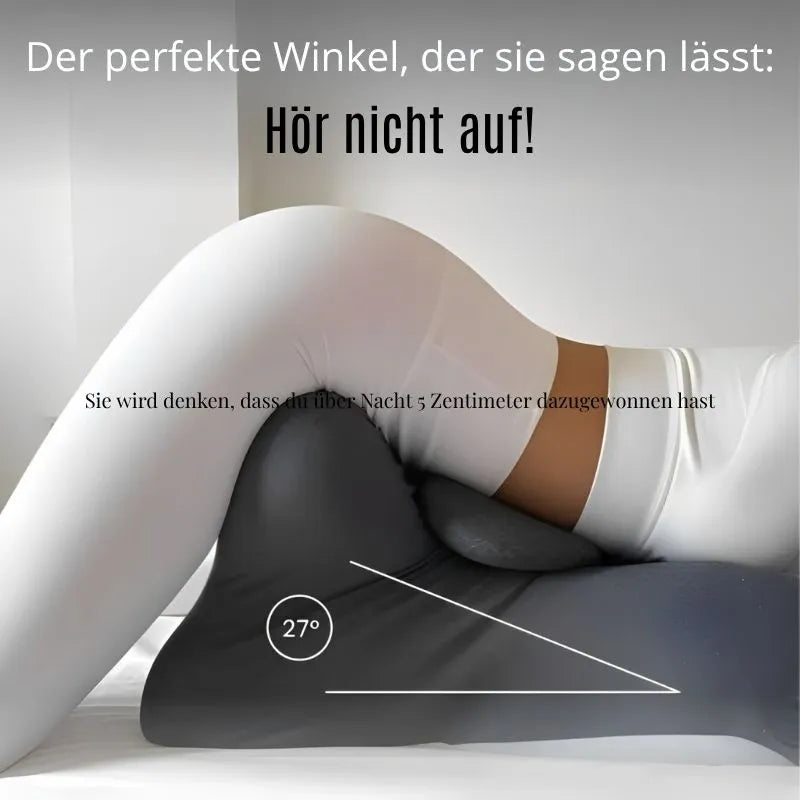
Most couples' first instinct is to improvise — an extra pillow here, a rolled-up blanket there. The problem is that regular pillows compress and lose their shape under pressure, which means the support disappears exactly when it's needed most. That's why the discomfort keeps coming back, no matter how many pillows get added to the pile.
Without Proper Support
- Constant repositioning that breaks the moment
- Lower back and hip strain the next morning
- Fatigue that builds up night after night
- Quiet avoidance that gets misread as disinterest
With Proper Alignment
- Stays in place — no readjusting mid-moment
- Spine and hips supported in a natural position
- Noticeably more energy and better sleep
- Closeness returns without either partner "trying harder"
The comfort difference is usually immediate — no more mid-moment adjusting, no more morning stiffness. It's designed to look like an ordinary support pillow, so nothing about your bedroom has to change except how it feels. And if it's not the right fit for you, a 30-day trial means there's no real risk in finding out.
Is this actually about a physical issue, or is it "just in our heads"?
Will it be obvious what it's for?
What if my partner and I have different needs?
What if it doesn't work for us?
Thousands of Couples Over 40 Have Already Found Their Way Back to Each Other
See current availability, pricing, and the 30-day risk-free trial on the official product page.
See How It Works → 30-day money-back guarantee · Discreet packaging · Free shipping